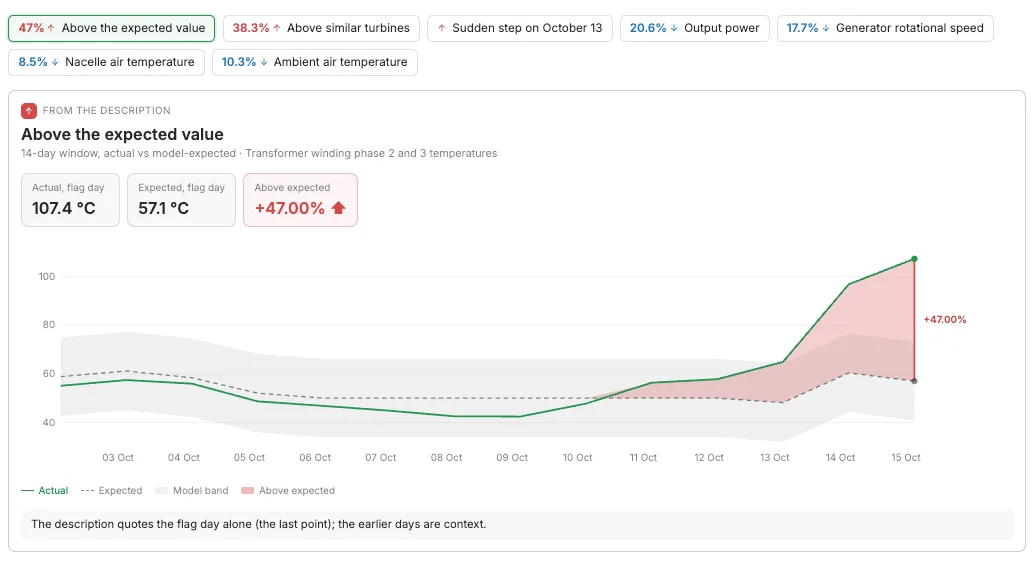
On 15 October 2026 Kavaken flagged a wind turbine whose transformer winding phase 2 and 3 temperatures had risen to 47.0% above the expected value and 38.3% above comparable turbines at the wind farm. The risk was rated low, and load and ambient temperature were both falling, so nothing on site demanded action yet. Kavaken pointed to the transformer ventilation and fan circuit as the leading cause. Two days later the first SCADA overtemperature warning appeared, with a power limitation. On 21 October the site team replaced the transformer fans and the 35 A fuse that feeds them. By 6 November the signals were back to normal and the flag was resolved.
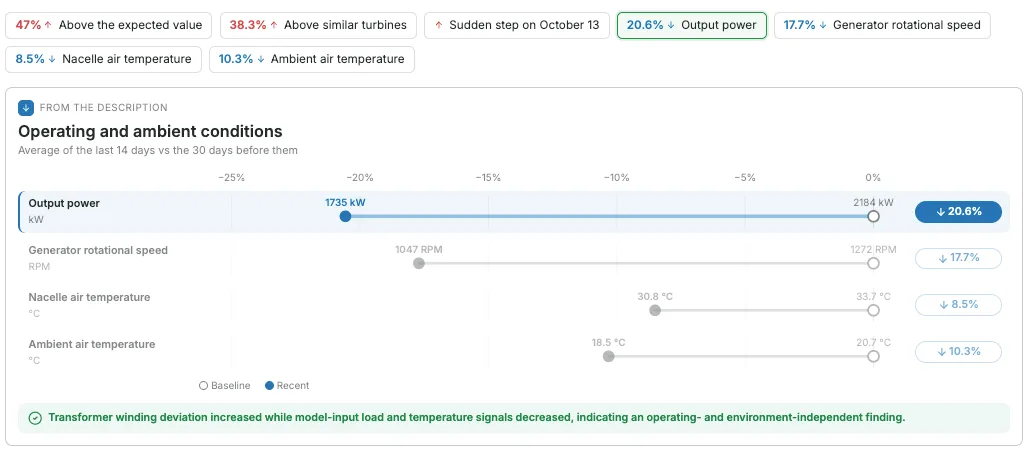
Less load, more heat
Over the 14 days before the flag, the turbine's operating conditions and its transformer winding temperatures moved in opposite directions.
The expected value already accounts for load and temperature. With all of these inputs falling, operating or environmental conditions could not explain the rise. The deviation was specific to this turbine and appeared on both phases at once, which pointed to the transformer's cooling rather than to the windings themselves.
22 days, step by step
SignalKavakenSite team
- Day −2 · 13 Oct 2026 · Signal
Winding temperatures step up suddenly
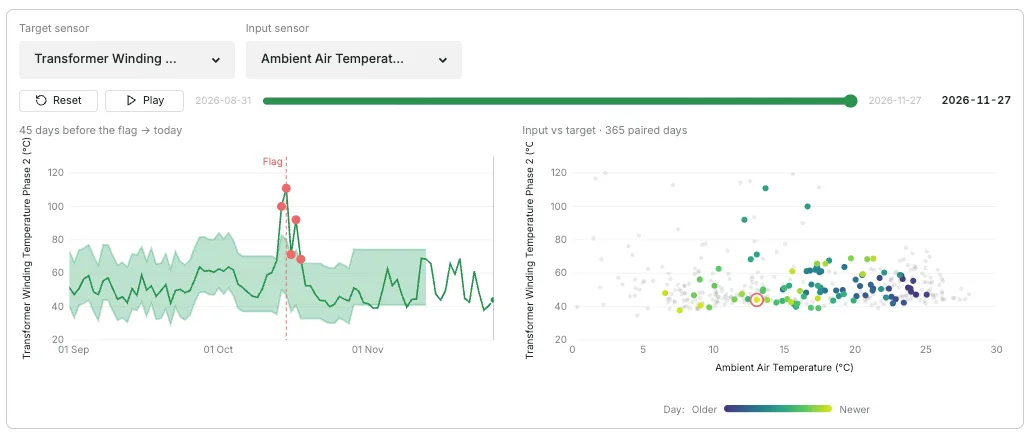
The deviation of the phase 2 and 3 winding temperatures from the expected value jumped from an average of 0.0% to 36.9%. The deviation from comparable turbines jumped from 0.6% to 34.1%. The new level held.
- Day 0 · 15 Oct 2026 · Kavaken
Kavaken flags transformer winding overheating
Kavaken flagged the windings at 47.0% above expected and 38.3% above comparable turbines, while load and ambient temperature were falling. It named insufficient performance of the transformer ventilation and fan circuit as the leading cause. It recommended verifying the cooling method, measuring fan supply, operating current and airflow, cleaning the air passages and measuring the contact resistance of the phase connections.
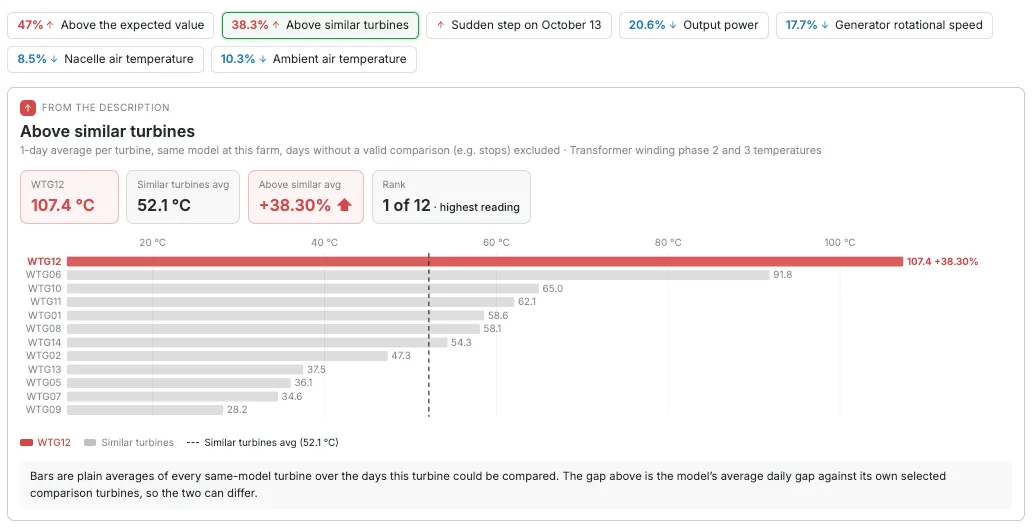
Figure 3. On the flag day the flagged turbine's winding temperature of 107.4 °C was the highest at the farm, 38.30% above the 52.1 °C average of same-model turbines. - Day 2 · 17 Oct 2026 · Signal
First SCADA overtemperature warning appears
SCADA raised a transformer overtemperature warning that lasted about 4.5 hours. A power limitation due to high temperature followed, lasting 2.59 hours, with an estimated 1,937.8 kWh of lost production.
- Day 5 · 20 Oct 2026 · Site team
Site team plans the work
The site team planned the intervention for 21 October.
- Day 6 · 21 Oct 2026 · Site team · Fix
Transformer fans and fan fuse replaced
The site team replaced the transformer fans and the 35 A fuse that supplies them. This matched the fan circuit Kavaken had pointed to.
Flag log, site team (translated): The transformer fans and the 35 A fuse for the fans were replaced.
- Day 9 · 24 Oct 2026 · Kavaken
Kavaken links the warning to the flag
Kavaken recorded the 17 October warning as an event related to the flag and asked for the date and details of the intervention. The site team confirmed the fan and fuse replacement.
Flag log, Kavaken (translated): The anomaly in the flag appears to have started showing up on site as a SCADA warning. If an intervention was planned, please enter its date; if it was done, its date and details.
- Day 22 · 6 Nov 2026 · Site team
Signals back to normal, flag resolved
The winding temperature signals had returned to normal and the intervention was judged successful. The flag stayed open briefly so the observation-period records could be reviewed together, and was resolved the same day.
Why it stayed hidden
Lower load and cooler air should have brought winding temperatures down. Instead they rose. A check that looks only at absolute readings against fixed limits sees nothing until a limit is crossed. Here that happened on 17 October, two days after the flag, when SCADA raised the first overtemperature warning and limited power. Kavaken compared the windings with what the model expected for the actual load and temperature, and with comparable turbines at the same farm. That made the deviation visible from 13 October.
The outcome
After the transformer fans and their 35 A fuse were replaced on 21 October, the phase 2 and 3 winding temperatures came back to normal. The winding temperature returned to within the expected band, and on 6 November the intervention was judged successful and the flag was resolved.
The fix came after one SCADA overtemperature warning and a 2.59-hour power limitation on 17 October. It came before the problem could grow further.
The client rated Kavaken's role in the resolution as key.
- Production
- 180 MWh
- Financial
- USD 12,000
- CO2
- 110 t
Avoided-loss potential: Kavaken's estimate of the loss that the early finding prevented. It is not a realized saving.
Takeaway
When a transformer runs hotter while load and ambient temperature fall, check the cooling fans and their supply before a limit trips. Comparing against expected values and comparable turbines shows the drift before SCADA does.