Kavaken flagged a wind turbine whose transformer phase 2 winding temperature was running 26% above expected values and 34.8% above the average of similar turbines. The pattern looked familiar. In January the same symptom had appeared on all three phases and then faded on its own, and that flag was closed with no work performed. Kavaken pointed to the transformer cooling air path: fans, filters, grills and air flow. In the last week of August the site team found that the actuator wire holding the transformer cooling-air flap had broken, and reconnected it so that the flap opens and closes again.
The same symptom, seven months earlier
An earlier Kavaken flag on this turbine was triggered on 7 January 2026 by a rapid rise in the phase 2 transformer winding temperature, together with phases 1 and 3. Because all three phases rose at once, it pointed to a shared cooling or compartment heat load issue rather than a single sensor or winding. The issue was reported to the OEM on 12 January. Around 29 January the anomaly disappeared on its own, and the flag was closed on 20 February with temperatures within limits and no work performed.
That history suggested a temporary cooling or ventilation effect rather than a lasting fault. When the symptom returned in August, the transformer phase temperature was rising faster than the generator phase temperatures, the transformer cabinet temperature and the nacelle internal temperature. That made a seasonal or general ambient effect less likely, and a local heat load or a loss of cooling performance more likely.
From flag to closure, step by step
KavakenSite team
- Day 0 · 11 Aug 2026 · Kavaken
Phase 2 winding runs 26% above expected
Kavaken flags the transformer: the phase 2 winding temperature is 26% above expected and 34.8% above the average of similar turbines, a consistent deviation. The recommendation: in a low-wind or low-production window, check the cooling fans, fan motor currents and air flow direction, then inspect the fan, filter and air inlet and outlet grills, and scan the transformer compartment with a thermal camera.
- Day 6 · 17 Aug 2026 · Kavaken
Risk level raised as phase 1 progresses
The anomaly on the phase 1 winding temperature progresses, and Kavaken raises the flag's risk level.
Flag log, Kavaken (translated): The flag level increased due to the progression of the anomaly calculated by the HVTrafo Phase1 Temp. Avg. sensor models. New flag risk level: 2.
- Day 13 to 20 · 24 Aug – 31 Aug 2026 · Site team · Fix
Broken flap actuator wire reconnected
In the last week of August the site team finds that the wire of the actuator holding the transformer cooling-air flap, at the rear of the transformer, has broken. They reconnect it, and the flap opens and closes actively again. The repair is reported on 14 October.
Flag log, site team (translated): At the rear of the transformer, the wire of the actuator holding the flap that opens and closes to cool the transformer had broken; it was reconnected. The flap was made to open and close actively again.
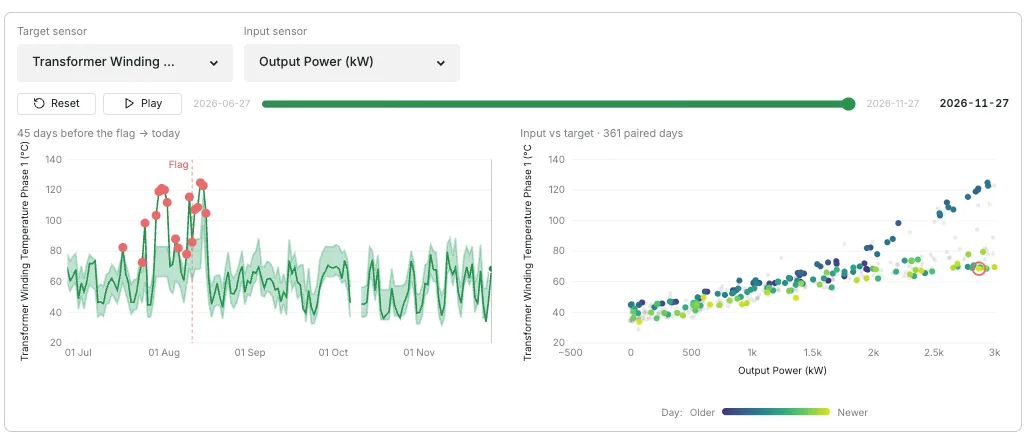
Figure 1. Transformer winding temperature, phase 1: peaks above 120 °C around the flag in August, then back within the expected band from late August through November. - Day 19 · 30 Aug 2026 · Kavaken
Anomaly drops below the threshold
The anomaly on all three transformer winding temperatures falls below the threshold. Kavaken asks the site team whether any intervention was made.
- Day 20 · 31 Aug 2026 · Site team
Site attributes the drop to low production
The site team replies that no work was done and that the temperature returned to its trend range because production was low.
Flag log, site team (translated): No work has been done. The temperature entered the trend range because production was low.
- Day 22 · 2 Sep 2026 · Site team
Check planned for the next maintenance
The flag moves to maintenance planned.
Flag log, site team (translated): It will be checked during maintenance.
- Day 52 · 2 Oct 2026 · Kavaken
All three phases stay below threshold
Kavaken again reports that the anomaly on the phase 1, 2 and 3 winding temperatures is below the threshold.
- Day 64 · 14 Oct 2026 · Site team
Repair reported and flag resolved
The site team closes the flag and records the repair of the cooling-air flap actuator, done in the last week of August. The action taken: opening the air flap for transformer cooling.
Why it stayed hidden
The symptom had come and gone before. In January the same rise on all three phases disappeared without any work and the flag was closed with temperatures within limits, which made a temporary ventilation effect look plausible. Winding temperature also follows production: when output is low, the temperature returns to its trend range, as the site team noted on 31 August. A cooling-air flap that no longer opens can stay out of sight until the transformer runs at high load.
The outcome
After the flap actuator wire was reconnected, the anomaly on all three transformer winding temperatures fell below the threshold on 30 August and was again below the threshold on 2 October. The winding temperature chart shows the values back within the expected band from late August.
On 31 August the site team attributed the return to range to low production. The repair of the flap actuator was reported on 14 October as done in the last week of August. The client rated Kavaken's role in the resolution as key.
- Production
- 120 MWh
- Financial
- USD 6,100
- CO2
- 80 t
Avoided-loss potential: Kavaken's estimate of the loss that the early finding prevented. It is not a realized saving.
Takeaway
When a transformer heat anomaly fades on its own and comes back, check the whole cooling air path, including the flaps and their actuators, not only the fans and filters. Low production can hide the fault for weeks.