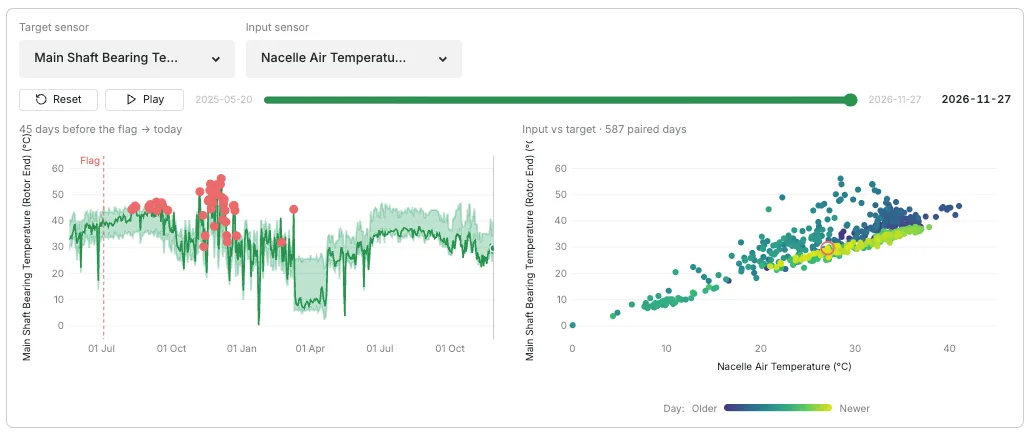
On 4 July 2025 Kavaken flagged an overheating trend on the main shaft bearing of a client's wind turbine, seen on the DTR RotBearTemp 1 sensor. The client's CMS had raised its own flag three days earlier. An earlier flag on the same bearing had been closed after oil was added in February 2025. No SCADA warning fired for another 69 days, and the warnings that followed cost no production. The site team changed a lubrication parameter, added grease and flushed the bearing. Each step brought short-term relief, but the trend continued. After a bearing over-temperature stop in March 2026, the main bearing was replaced during a long stop, and the anomaly disappeared.
A repeat on the same bearing
This was not the first anomaly on this bearing. An earlier flag had been closed after oil was added in February 2025. In the weeks before 4 July 2025, an overheating pattern built up again on the DTR RotBearTemp 1 sensor.
The client's condition monitoring system raised a flag on 1 July 2025. Kavaken's flag followed three days later. The two systems confirmed each other, and by 31 July the site team had placed the main bearing in the replacement scope.
From flag to replacement, step by step
KavakenSite teamSignal
- Day 0 · 4 Jul 2025 · Kavaken
Kavaken flags main bearing overheating
Kavaken flagged anomalous heat behaviour on the main shaft bearing, with an overheating indication on the DTR RotBearTemp 1 sensor and an upward trend. The client's CMS had raised a flag on 1 July.
- Day 3 · 7 Jul 2025 · Site team · Fix 1 of 4
Lubrication parameter changed
The site team changed the lubrication parameter. The CMS vibration data improved, and the damage was expected to be small. The bearing was kept under watch.
Flag log, site team (translated): The lubrication parameter was changed on 07/07/2025. An improvement was observed in the CMS vibration data.
- Day 27 · 31 Jul 2025 · Site team
Main bearing added to replacement scope
The site team included the main bearing in its replacement scope.
Flag log, site team (translated): The main bearing has been included in the replacement scope.
- Day 42 · 15 Aug 2025 · Site team · Fix 2 of 4
Grease added to automatic lubrication
The turbine was stopped so that a grease container could be added to the rotor bearing's automatic lubrication system.
- Day 75 · 17 Sep 2025 · Site team · Fix 3 of 4
Main bearing flushed
The site team carried out a main bearing flushing. The first SCADA high-temperature warnings had fired on 11 September, for 15.8 hours, and fired again on 18 September, for 17.1 hours.
- Day 118 · 30 Oct 2025 · Kavaken
Relief is short-term, trend continues
Kavaken reviewed the August and September interventions against the bearing temperature. Both brought short-term improvement, but the anomaly trend continued.
Flag log, Kavaken (translated): Short-term signs of improvement are seen after the August and September interventions. However, the anomaly trend was seen to continue.
- Day 125 to 159 · 6 Nov – 10 Dec 2025 · Signal
Seven more high-temperature warnings
The DTR RotBearTemp 1 high-temperature warning fired seven times in five weeks. The warnings lasted from 6.0 to 72.2 hours and cost no production. In January 2026 the bearing still diverged from the site average.
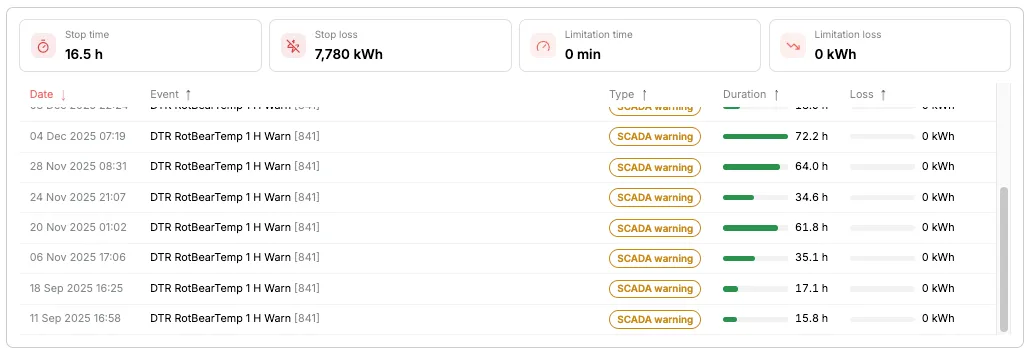
Figure 2. SCADA events from September to December 2025: high-temperature warnings on the rotor bearing lasting up to 72.2 hours, each with 0 kWh loss. - Day 249 to 294 · 10 Mar – 24 Apr 2026 · Site team · Fix 4 of 4
Over-temperature stop, main bearing replaced
Three days after a low-level warning on the rotor bearing grease container, a high-temperature warning was followed by a bearing over-temperature stop of 16.5 hours and about 7,780 kWh. The turbine then stayed down until 24 April. The main bearing was replaced during this stop.
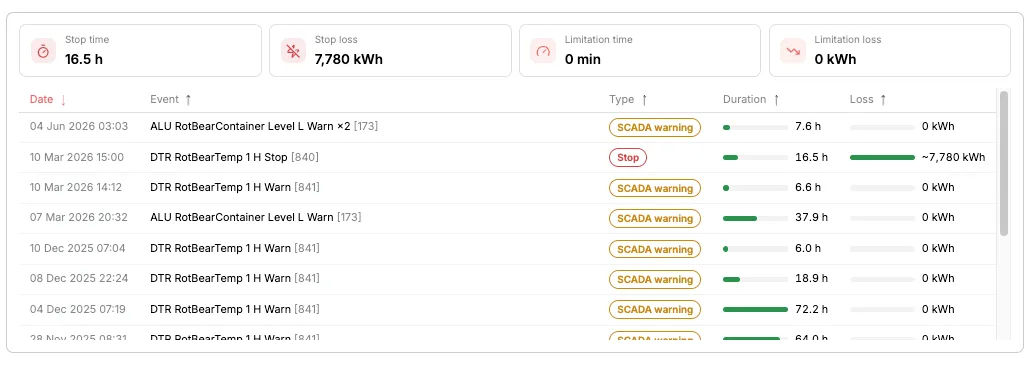
Figure 3. SCADA events up to June 2026: the high-temperature warning and the 16.5-hour over-temperature stop on 10 March 2026, with about 7,780 kWh lost. - Day 353 · 22 Jun 2026 · Kavaken
Anomaly gone after the long stop
Kavaken confirmed that the anomaly had disappeared after the stop from 10 March to 24 April.
Flag log, Kavaken (translated): A long stop period is seen between 10 March and 24 April, after which the anomaly disappeared.
- Day 368 · 7 Jul 2026 · Site team
Flag resolved with bearing replacement
The site team recorded the main bearing replacement, and the flag was resolved.
Why it stayed hidden
When Kavaken flagged the bearing, SCADA showed nothing. The first high-temperature warning came 69 days later. The ten warnings that followed, up to March 2026, cost no production, so the turbine kept running normally. Each lubrication measure brought short-term improvement, which made the trend look under control between warnings. The turbine stopped on bearing temperature for the first time 249 days after the flag.
The outcome
The main bearing was replaced during the stop from 10 March to 24 April 2026. After the turbine returned, Kavaken saw that the anomaly had disappeared. The chart shows the rotor-end bearing temperature following its expected band after the restart.
The lighter measures, a lubrication parameter change, a grease addition and a flushing, each brought short-term improvement, but none stopped the trend. A low-level warning on the rotor bearing grease container also fired twice on 4 June 2026, after the replacement.
The client rated Kavaken's role as helpful.
- Production
- 410 MWh
- Financial
- USD 31,000
- CO2
- 260 t
Avoided-loss potential: Kavaken's estimate of the loss that the early finding prevented. It is not a realized saving.
Takeaway
When lubrication measures bring only short-term relief on a main bearing temperature trend, keep tracking the deviation from the site average and plan the replacement window before an over-temperature stop forces it.